Service file / social media strategy for restricted brands
Social Media Strategy
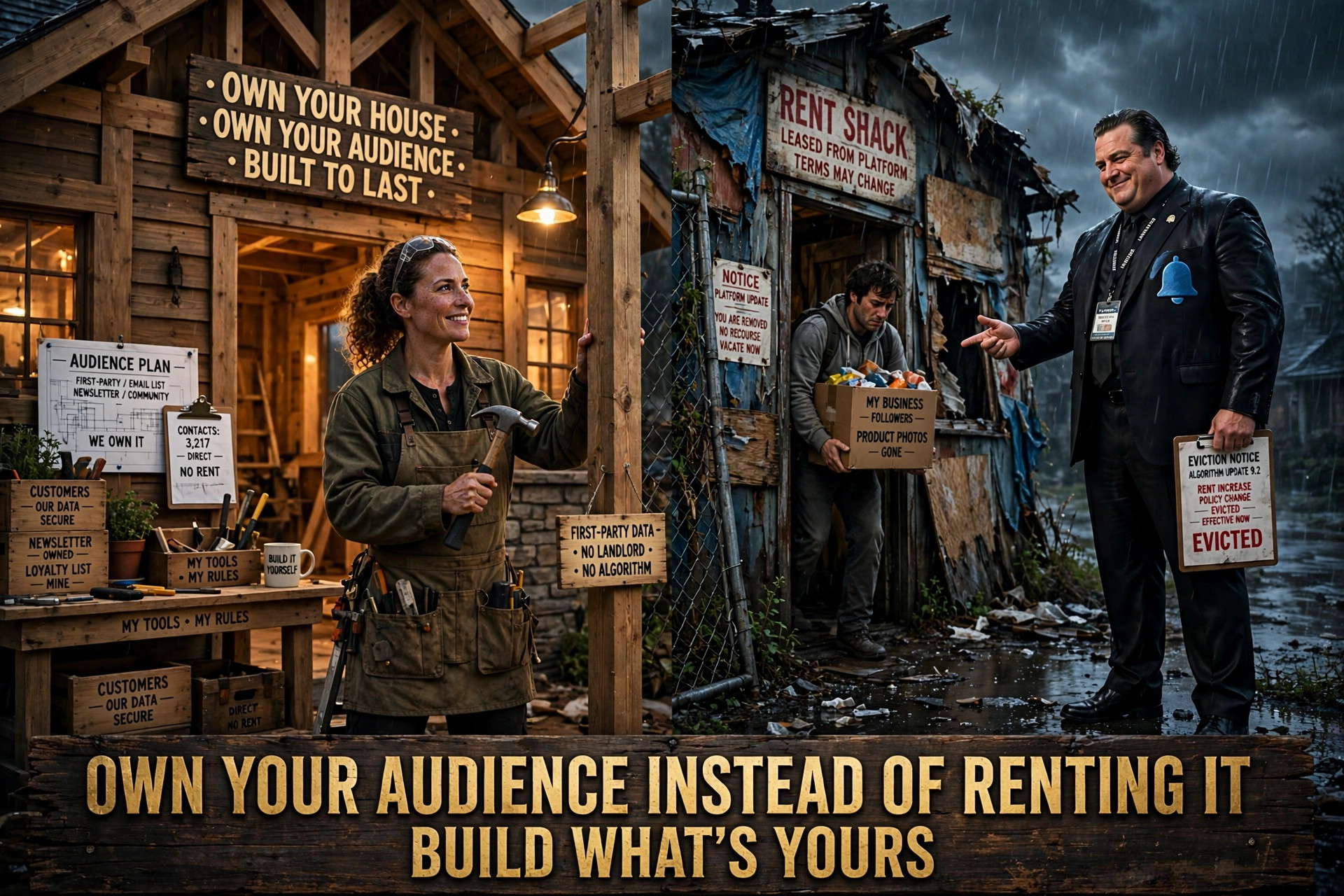
Build an audience you actually own — not one rented from an app that can evict you. Our founder got shadowbanned, throttled, and canceled across platforms for a decade. He learned the hard way: followers you can't reach are just a number on someone else's server.
Own your audience instead of renting it.
0audience segments defined
0fallback channels ready
0audience nobody can evict
Interactive self-check
Audit your rented empire
A short checklist to map your channel purpose, audience fit, moderation load, and owned destinations — and to see how much of your reach survives a bad Tuesday. It's a conversation starter, not a score, and not a promise of growth or revenue.
An audience you own, not rent
Social channels can be useful and fragile in the same afternoon. A post educates thousands today and gets removed tomorrow. We design a channel mix that treats social as the conversation and discovery layer — never the only place your customers can find you.
The strategy pairs durable owned content with platform-native formats. Your site, your email list, your community guidelines, your support knowledge base: that's the archive. Social posts are the invitations — short, clear, human, careful about claims. And we write a moderation playbook so your team knows how to answer sensitive questions without pouring gasoline on them.
We also plan for bad days, because we've lived them. A content pause protocol. Escalation roles. An incident log. A way to reach your audience when a provider changes policy overnight. Rebellious doesn't mean reckless — it means you know what you're willing to say, where you'll say it, and what you'll do when the landlord changes the locks.
Plain-English promise: We'll tell you what we know, what we're still testing, and what no honest studio on earth can guarantee. Reach included.
The channel stack
01 Owned hub: your site, your list, your rules
02 Community: listen first, moderate with a spine
03 Discovery: social, search, partnerships
04 Review: learn, document, adapt
Posting with a purpose (and a backup plan)
We turn channel strategy into named decisions: what each channel is for, who it's for, what a good post does, who moderates, how often you publish, and where the canonical version lives. Every decision gets an owner and a revisit date — so a content choice doesn't become permanent just because nobody remembers who made it.
No motivational fog. Just a system a busy team can run without the calendar quietly becoming a second full-time job.
Dispatches from the deplatformed
The dead account is rarely the real problem. Usually it's upstream — everything lived on one platform, no email list, no owned hub, one person holding all the logins. We trace the whole path from audience to revenue before prescribing more posting. Then we write it down: what changed, why, and what would make us change course.
Continuity is the quiet killer. Vendor changes terms, an account gets paused, the one person who knows the process leaves — and suddenly the brand's entire community lives inside someone else's algorithm. We plan exports, fallback routes, named escalation, and recovery notes so one machine saying "no" doesn't stop your whole operation. And when the constraints aren't ready, we'll say it straight: narrow the focus, build the owned base first. A smaller honest result beats a polished promise your team can't keep.
Us vs. the vanity-metric vendors
Approach
Short-term feeling
Long-term risk
Our alternative
Post everywhere, every day
Busy
Burnout plus a rented audience
Owned hub first, social as invitations
Chase every trend
Exciting
Trust risk when the meme misfires
Pillars that survive a busy month
One person holds all the logins
Easy
Bottleneck and security risk
Documented roles, backup admins
Channel resilience in practice
A resilient social strategy can lose an account without losing the relationship. Keep the canonical version of everything important on your site or email list. Export consented contacts where lawful. Link back to a stable resource. A platform post is a useful invitation — it is not your filing cabinet.
Owned: website, email, community guidelines, help content. Nobody can evict you from these.
Learning: questions, saves, qualified visits, support themes — not follower theater.
Moderation playbooks define response tone, evidence requests, privacy boundaries, and when to take a conversation private. Never publish someone's personal info to win an argument. The sharpest brand voice on earth can't out-post a preventable safety mistake.
Content people can actually use
We build recurring formats around education, process, behind-the-scenes context, customer questions, and values. Every format gets a job and a destination. Captions and alt text stand on their own. Motion stays optional. The same information exists in text. The result is less brittle, more searchable, and kinder to people who don't experience the internet at full volume.
Hard questions, straight answers
What if we get banned mid-campaign?
Then the campaign continues — because we never built it on rented land alone. Every follower gets a path to your email list, your site, your community. A ban becomes an inconvenience, not an extinction event.
Do we need to be on every platform?
God, no. Two channels done well beat six done badly. We pick where your actual customers are and where the ban risk is survivable, then go deep.
Can you make us go viral?
No, and virality is a sugar high anyway. We build a repeatable content system that compounds — the unsexy posts that bring customers beat the viral post that brings applause.
A social presence with a spine, not a content treadmill
Social media strategy is the operating system behind the posts. Who you're speaking to, what you can safely say, how a comment becomes a conversation, how a team learns without losing its voice. For a restricted or misunderstood brand, every platform has a different tolerance for language, links, images, and promotion. We build a practical system that can be bold without being reckless, human without oversharing, and consistent without sounding like a robot in a branded hoodie.
Define the audience and the useful promise
We separate audiences that deserve different answers: curious newcomers, existing customers, partners, prospective staff, people looking for support. Each gets a job-to-be-done, a level of knowledge, and a reason to follow. "Grow followers" is not a strategy. A better objective: make qualified prospects understand the offer, help customers use the service, make the brand easier to recommend.
Message pillars that survive a busy month: education, proof, process, people, culture, invitation. Pillars are boundaries, not quotas. A post earns its place by teaching, showing, clarifying, or inviting a real response. We write a voice guide with examples of confident, playful, careful, and crisis language — so multiple contributors sound related without being cloned.
Platform decisions and adaptation
Every platform rewards different behavior and enforces different rules. We pick channels by audience access, content strengths, moderation burden, and business risk. One long educational thread can become a short video script, a carousel, an email, and a searchable article — but we never paste the same caption everywhere. Links, hashtags, music, nudity rules, political content rules, ad eligibility: they all change, so the plan leaves room to adapt.
We keep a platform matrix: allowed formats, approval needs, account owners, escalation contacts, archive method, and what must never be posted. A social account is a business asset — treat it like one. Multi-factor authentication, backup administrators, recovery codes, least-privilege access. And never let a departing freelancer remain the only human who can reset the account.
Plan content without manufacturing noise
A useful calendar balances planned moments with room for real-time response. We batch research, interviews, filming, design, captions, alt text, approvals, and scheduling — then keep capacity for comments and news. Every asset gets a purpose, audience, source, rights status, accessibility notes, destination link, and an expiration date if the claim can change.
Repurposing is an efficiency decision, not permission to repeat yourself. One customer question can become a myth-versus-fact post, a deeper guide, a short demo, and a support macro. Credit collaborators, clear image and music rights, keep release records where people or private spaces appear. Strip location clues and personal details that could expose someone who didn't agree to publicity.
Community management is customer experience
Response tiers keep it human: a simple question gets a prompt answer; a complaint gets acknowledgement, a move to a private channel when personal details are involved, and a documented handoff; harassment, threats, doxxing, and spam get moderated under a published internal rule — not an impulsive late-night argument. Staff need explicit permission to pause, hide, report, or escalate.
Response templates should sound like a person while staying accurate: what we know, what we're checking, when we'll reply, where the official answer lives. Never ask someone to post sensitive info publicly. Screenshots can preserve context, but store them securely and limit access. A healthy community isn't one with zero criticism — it's one where the team responds predictably.
Paid social and organic boundaries
Organic reach and paid promotion are different products. We test organic language for comprehension before spending a dime — but we never assume a post can be promoted. Platforms restrict adult, health, financial, political, and identity-related claims and imagery. We keep an approved-claims library, a landing-page checklist, audience exclusions, and a stop rule for when comments or performance signal confusion.
Targeting respects privacy and platform policy. First-party consented audiences where appropriate, no sensitive inferences, honest data-use explanations. A pixel is not a moral blank check. We measure cost per qualified action and downstream quality — not cheap clicks.
Measurement and learning
Reach and impressions are context. The real signals: saves, meaningful comments, qualified profile visits, referral sessions, sign-ups, assisted conversions, response time, sentiment themes. For a service brand, one DM that becomes a qualified consultation can matter more than a viral joke. We tag links consistently, separate campaign traffic from community traffic, and keep a note about what changed.
Experiments need a hypothesis: a clearer hook might improve saves among a particular audience; a shorter form might cut support questions. Test one variable where practical. Never declare victory off a single lucky post. And review the negative signals too — unfollows after a campaign, repeated questions, moderation volume, staff burnout.
Failure modes to avoid
Trend chasing: a meme that clashes with your values can cost more trust than it earns attention.
Founder-only access: one person becomes a bottleneck and a security risk. Document the roles.
Content without a destination: if every post begs for a sale, people stop listening; if none explains the next step, interest goes nowhere.
Unmoderated comments: visible harassment makes a community unsafe. Publish standards and apply them.
Automation without review: scheduled posts can collide with a crisis. Keep a pause procedure and a human check.
Frequently asked questions
How often should we post? The sustainable cadence is the one that leaves room for quality, replies, and measurement. Consistency beats an ambitious schedule that collapses by March.
Can you make restricted content perform on every platform? No. We work inside each platform's rules and build an owned content home — so the brand never depends on a single feed.
Should comments be turned off? Usually not by default. Clear moderation, filters, and escalation preserve conversation while protecting people.
What does success look like? Defined with the business: qualified conversations, customer education, recruitment, referrals, some other measurable job. Not applause alone.
Make the team sustainable
Social strategy dies when the calendar quietly becomes a second full-time job. We set an approval SLA, batch the low-risk work, reserve time for replies, and rotate moderation so one person isn't absorbing every difficult interaction. A monthly editorial retro asks which questions repeated, which assets got reused well, which posts created support work, and what the audience is teaching us. Sometimes the answer is to publish less and improve the destination.
We archive high-performing posts with their context — audience, hook, format, destination, rights, comments, outcome — so a future team can learn instead of imitating blindly. When a platform changes a rule, the matrix shows the impact. Owned email, a useful website, and a portable customer relationship protect the brand from waking up to find its entire community living inside someone else's algorithm.
Accessibility is part of the voice
Captions, transcripts, descriptive alt text, readable contrast, clear link destinations — not extras for a niche audience. They make a post understandable in a loud room, on a slow connection, or with the sound off. We bake accessibility into the content brief and review it before scheduling. The brand can stay mischievous; the information stays available to whoever needs it, instead of hiding behind a clever visual.
Keep the archive useful
We preserve captions, approvals, rights notes, destinations, and outcomes in an accessible archive. That makes handoffs easier and stops the team from repeating an expired claim just because the old post still looks good. A quarterly cleanup removes dead links, updates evergreen answers, and records why a sensitive post got retired. Good governance lets a lively voice stay lively without leaving old mistakes on permanent autoplay.
Measure the quiet wins
Not every useful post gets a public reaction. A saved explainer, a private question answered safely, a customer who finds the right support route — those count. We track those signals where consent and measurement allow, and stay honest about what can't be observed. Quiet usefulness is still strategy.