A smart app is a useful place, not a tiny billboard
An app earns its keep by making a recurring task easier. Reordering the favorite. Checking the delivery. Booking the appointment. Finding the location. Asking the private question. Saving the recipe. Collecting rewards without a paper punch card that's seen things.
The best app strategy starts with behavior, not technology. We map what customers already try to do, where they lose patience, what your team explains for the hundredth time, and which moments deserve a nudge. Then we decide if an app is genuinely the answer. Sometimes it is. Sometimes the right answer is a better mobile site, a staff tablet, an in-store display — or all of them talking to each other. We don't sell an app-shaped solution to a problem that needed a less irritating form.
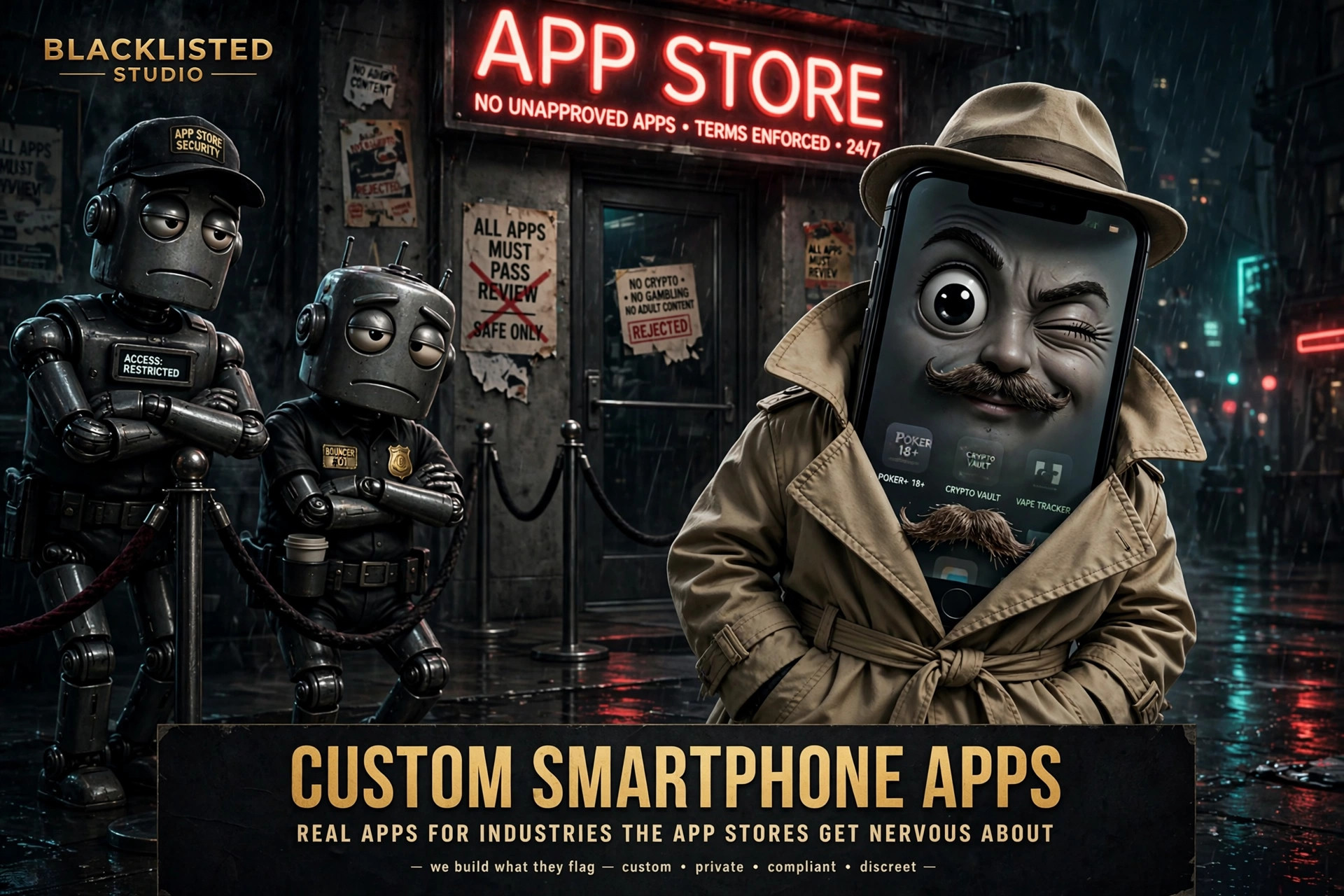
For a blacklisted or high-friction brand, a good app builds a direct relationship that doesn't depend on rented reach. Customers choose the channel. The brand gets room to explain itself. Useful updates land where people already live — their pockets. That's the difference between a front door and some guy shouting through your letterbox.
What a custom app can do for a complicated business
Reward the relationship
Points, tiers, digital stamps, birthday offers, referral rewards, saved favorites, personalized offers. Rules your team can actually configure — connected to the systems you already run.
Make the next purchase easier
Pickup, delivery, appointments, subscriptions, reorders, age checks where required, clear status updates. Customers should know what happens next without interrogating a chatbot at 2 a.m.
Put help where the question happens
Support portals with searchable answers, secure messages, ticket status, appointment changes, returns guidance, escalation paths. Good support tech reduces repetition without hiding the human door.
Turn inventory into understanding
Products with availability, education, comparisons, compatible accessories, responsible-use info, location-specific details. A catalog should help someone choose — not hurl 400 thumbnails at them.
Reach customers who opted in
Permission-based push, email handoffs, in-app messages, preference centers. We design frequency controls, quiet hours, and unsubscribe paths so direct communication stays welcome — because one spammy blast burns the channel for everyone.
Make the strange idea work
Product finders, field-service tools, member communities, staff dashboards, education modules, calculators, location networks, AI-assisted experiences. Bring the weird bit — we'll help separate the brilliant from the expensive.
The machinery behind the pretty buttons
Customers see screens. A serious app is a small operating system for decisions, content, identity, permissions, and follow-through. We plan the unseen parts early: how a product enters the catalog, how stock changes, how an offer gets approved, how a customer proves account ownership, how staff roles stay limited, what happens when an integration goes down. The app should degrade gracefully — not collapse like a cheap folding chair at a board meeting.
Depending on the brief, the build can include a mobile client, a web admin console, a content layer, inventory or point-of-sale connections, notifications, analytics, support tools, and an audit trail. We document which system owns each fact. Inventory belongs to the POS. Copy belongs to the content team. Reward balances belong to the loyalty service. Clear ownership keeps the app from telling three different truths at once.
We also plan the release lifecycle. A small first release proves the most important behavior — it doesn't recreate every feature anyone ever mentioned in a meeting. Minimum useful product. Pilot audience. Success signals. A ranked backlog. Later releases can add geofencing, barcode scanning, camera or Bluetooth features, location-aware content, wearables, staff workflows, deeper personalization — when the evidence says they earn their maintenance cost.
| Layer | Question we answer | Useful output |
|---|---|---|
| Experience | What should the customer or staff member accomplish? | Flows, prototypes, accessibility notes |
| Data | What information is needed, and who owns it? | Data map, consent rules, retention decisions |
| Operations | Who updates offers, products, screens, and answers? | Admin tools, approval paths, runbook |
| Learning | How will we know the app is useful? | Event plan, feedback loop, release criteria |
Built for the industries mainstream software leaves standing outside
A cannabis retailer may need location-specific inventory, adult verification, education, loyalty, and responsible-use content. A fintech or crypto company may need identity checks, transaction clarity, fee disclosure, security prompts, and support that doesn't vanish behind a ticket number. A supplement brand may need product education, subscription management, evidence-aware claims, and a clean line between wellness info and medical advice. An adult entertainment company may need age-gated experiences, creator tools, scheduling, consent-aware media handling, and discreet notifications.
For vape companies: calculators, saved recipes, stock reminders, age controls, plain safety info. For alternative events: tickets, memberships, venue directions, private updates, last-minute changes. For a restricted service provider, a staff app can matter more than a public one — intake, case notes, document status, appointment coordination, a secure way to explain what happens next.
The common thread isn't an industry. It's a business whose customers need more context than a platform profile allows. An app gives that context room to breathe: explain the product, set expectations, answer the recurring questions, record preferences, make the next step less mysterious. It can't make unlawful conduct lawful or turn a weak claim into evidence. But it can make an honest business dramatically easier to understand.
Three field notes from the app laboratory
These are the kinds of systems we build and the product decisions they demonstrate. Client details stay private — the point is range, not a victory lap with suspiciously perfect numbers.
Have-a-Heart AI budtender and loyalty companion
For Have-a-Heart cannabis stores, we designed a conversational AI budtender that recommended products from current store inventory — not some imaginary strain three counties away. It explained differences in plain language, moved overstock a location needed gone, suggested compatible vape devices, and taught responsible setups. It also supported buy-online, pickup-in-dispensary for same-day collection: a faster road from discovery to a confirmed store visit. Useful and relaxed — not a robotic sales script in a green hat.
The experience also covered loyalty, store directions, upcoming sales, and customer education. Product suggestions grew out of what the customer actually asked for instead of interrupting every sentence with a coupon. The trick wasn't pretending the assistant knew everything — it was giving it a useful lane, current information, and a personality that made browsing feel less like reading a spreadsheet. AI explores the choices; the business keeps the final call.
Vape toolkit for builders and mixers
This one's personal — our founder ran seven vape shops, and he knows exactly what the counter crowd wants. We designed a toolkit around elite hobby tools and saved flavor recipes: Ohm's law walkthroughs, coil-build comparisons, PG/VG and nicotine calculators, saved builds and recipes, personal notes that survive to the next visit. The educational design showed its math — warnings, units, assumptions, plain explanations — because a calculator that hides its work is a tiny abacus with trust issues.
The retention layer tied saved projects to sensible inventory reminders. With explicit consent and transparent settings, the system could estimate when supplies might run low and surface a relevant offer — using the customer's own purchase history as the planning signal. Useful, not creepy.
Branded crypto wallet and service companion
For a crypto company, we designed a branded wallet direction that made an approved swap flow actually understandable: clear balances, fee disclosure, confirmation screens, security prompts, transaction status, an easy path into the company's legitimate services. Complicated doesn't have to mean cryptic — fees, balances, status, and "what happens next" all visible. The concept also included a news ticker for company updates in a channel the brand controlled, instead of hoping every important message survived the social-media blender. Clear language, honest confidence levels.
Android: an ecosystem, not one rectangle
A customer might carry a budget phone with no storage, a flagship with a high-refresh display, a tablet at your counter, a kiosk in the store, a wall-mounted menu, or an Android TV looping product education. We design around the actual hardware, the actual network, the staff workflow, and the update process — not the fantasy where everyone owns the newest phone and lives next to a fiber line.
Our Android work spans customer apps, staff tablets, kiosk interfaces, in-shop menus, digital signage, and ad networks rotating sales materials, menus, educational clips, and commercials across your own screens. Content gets scheduled by location, time, inventory state, campaign, or device group. Operators get a simple control surface, preview mode, approval workflow, offline fallbacks, and a record of what played where. Otherwise the "network" becomes twelve televisions showing twelve versions of last year's sale.
Android's flexibility lets us match hardware to the job. We test on representative devices, plan for patchy connections and tired screens, and define the minimum supported environment before launch. Analytics track useful signals, not surveillance theater: completed orders, saved products, support resolution, loyalty use, screen uptime, staff task completion.
Browse, order, learn, return.
Manage stock, service, and updates.
Schedule content and permissions.
Menus, education, and campaigns.
iOS, with Apple's rules in the room
iOS customers expect polish: predictable navigation, honest privacy explanations, interfaces that respect the system's conventions. And Apple runs a famously particular front door. We design for that early — familiar navigation, thoughtful permission moments, clean account flows, a strong first impression — instead of bolting it on after the prototype has grown elbows.
We build iPhone and iPad apps with responsive layouts, secure sign-in, biometrics where it fits, deep links, widgets, push, offline states, purchase flows, accessibility, and carefully scoped AI. The goal: an app that feels at home on the device and still sounds unmistakably like your brand.
Three additional iOS concepts
- Smoke-shop loyalty passport: multi-location rewards for a smoke-shop chain — store-specific catalogs, digital stamps, points, birthday rewards, favorites, location-aware offers, a clean handoff from browsing to pickup. Customers see which location has the item, save lists, scan receipts for missing points, and pick their alert preferences. Managers publish local offers without waiting on an app release; the central team keeps the brand consistent. Our founder ran a seven-shop chain — he knows exactly what this has to survive.
- Supplement-company workout partner: an iPhone companion that turns a supplement brand into a daily training habit instead of a tub on a shelf. Goals, weekly routines, logged sets and recovery notes, short mobility sessions, reminders around the user's calendar, private progress history. Product education appears beside relevant routines — without pretending powder replaces sleep, food, coaching, or medical advice. The brand gets a real feedback loop: which programs people finish, where they stall, what actually helps.
- Live-now fan alerts for an adult webcam platform: a discreet streaming companion — follow favorite entertainers, set notification preferences, see who's online, jump into a live room without wading through a noisy feed. Quiet hours, favorites, performer announcements, tip-menu previews, schedule cards, "do not disturb unless this person is live." Entertainers publish status updates from creator tools; fans control frequency and mute channels. Less frantic refreshing, more intentional discovery — the platform's personality in the details, not in a push-notification ambush.
These three show why iOS work isn't resizing a website. Different rhythms: the smoke-shop app runs on repeat visits, the workout partner on consistency, the live-stream app on timely presence. We design the notification language, home screen, account model, and content cadence around that rhythm — so the app feels like a useful companion, not a branded folder of buttons.
Intelligent apps without the robot uprising
AI earns its place in an app when it has a clear job and good material: an assistant answering from your knowledge base, recommendations from current inventory, a support-thread summary, a staff drafting helper, a replenishment nudge, onboarding that adapts to what the customer picks. The best version feels like a clever teammate — not a glowing oracle in a trench coat.
These apps improve in ordinary, visible ways: better answers from approved content, smarter recommendations from real feedback, smoother journeys as people show us where they stall. We pair that flexibility with an easy human handoff and a clear way to tune, pause, or retire a feature. The anti-Skynet plan is simple: give the machine a job, give a person the steering wheel, keep the brake within reach.
From odd idea to app people keep
Discovery sprint first: customer jobs, business constraints, data sources, device targets, policy boundaries, the smallest useful release. Then a clickable flow that makes the experience testable before engineering gets expensive. We define the content model, account and consent behavior, integration boundaries, analytics plan, accessibility requirements, and failure states. Then we build in slices, test on real devices, prep store materials, pilot with a controlled group, and improve from evidence.
Good app work includes the unglamorous parts: empty states, expired sessions, bad addresses, missing inventory, failed payments, dead connections, notification preferences, account deletion, staff permissions, content approvals, backups, monitoring, release notes. Nobody applauds a graceful error message. Everybody remembers the app that didn't make a bad day worse.